The journey to life · chapter 13
How Birth Works: Labour and the First Breath
Birth is hard work for both of them. The womb is a muscle, and in labour it tightens in waves called contractions. Each lasts about a minute, and in the busiest part they come every two or three minutes. Each one pulls the cervix, the neck of the womb, a little thinner and a little more open, from closed to about 10 centimetres across: wide enough for the baby's head. Then the baby comes down. It tucks its chin in, turns its head to fit the shape of the pelvis, and the soft plates of its skull slide closer together so that it can pass. It slips under the pubic bone, its head is born, it turns back, and its body follows. In its first seconds outside, the baby takes its first breath. The fluid leaves its lungs, they fill with air, and its blood starts to go round a new way: through the lungs instead of past them. Its skin turns from bluish to pink. The cord is clamped after a minute or more, and a little later the placenta comes away from the wall of the womb and follows. About one baby in five in the world is born by caesarean section instead, through an opening made in the mother's belly and womb, and the first breath is just the same.
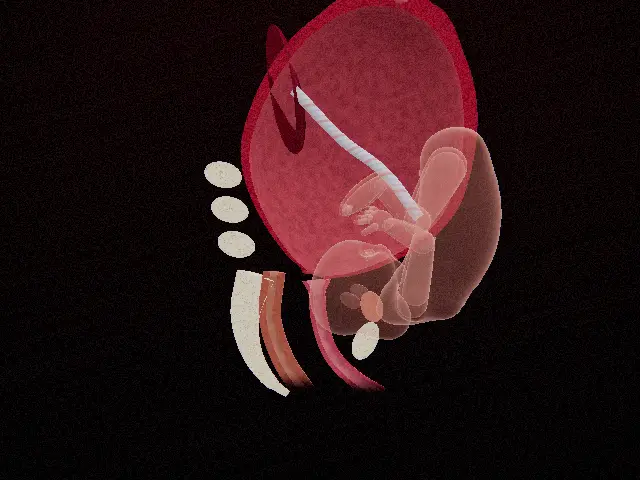
- Where
- Uterus, cervix and birth canal · in section
- How long
- Labour: often 12 hours or more the first time
In numbers
- MeasuredThe cervix opens to about 10 cm
- EstimateA first labour often takes 12 hours or more, later ones less; it varies a great deal
- EstimateIn active labour, a contraction about every 2–3 minutes, lasting about a minute
- MeasuredAbout 1 in 5 babies in the world is born by caesarean section
- MeasuredThe hole between the heart's upper chambers closes with the first breaths; the vessel that bypassed the lungs closes within days
- MeasuredThe cord is best clamped after at least a minute
- DrawnThe section, the baby and the pace are drawn: a labour of hours is shown in about a minute
Every number is labelled measured, an estimate or drawn: how we know.
The science
Labour has three stages. In the first, contractions thin (efface) and open (dilate) the cervix: a latent phase, often slow, to about 5 cm, and then the active phase, from 5 cm to full dilation at about 10 cm. In active labour contractions usually come every 2–3 minutes and last about a minute. A first labour often takes 12 hours or more and later ones less, and it varies a great deal; the World Health Organization advises that the active first stage usually lasts up to 12 hours in a first labour and up to 10 in later ones. In the second stage, from full dilation to the birth, the head goes through the cardinal movements: it engages in the pelvis, comes down, flexes (chin to chest, so that its smallest diameter, about 9.5 cm, leads), turns from facing the mother's side to facing her back (internal rotation), extends under the pubic arch to be born, then turns back (restitution and external rotation), and the shoulders and the body follow. The bones of the skull are not yet joined: they overlap at their seams (moulding), and the fontanelles, the soft spots, let the head change shape a little. At birth the fluid in the lungs is cleared, partly squeezed out in the canal and mostly absorbed; the first breaths open the air sacs, the vessels of the lungs relax, and the pressure in the left side of the heart rises above the right, which closes the flap over the foramen ovale, the hole between the upper chambers; the ductus arteriosus, the vessel that carried blood past the lungs, closes over the next days. Most babies breathe on their own within about half a minute. Waiting at least a minute before clamping the cord gives the baby extra blood and iron. In the third stage the placenta comes away, usually within half an hour, and the womb's muscle clamps down and closes the vessels where it was. About 1 in 5 births in the world is by caesarean section, and the share is rising.
In Endo-View
This is chapter 13 of the journey to life, an interactive 3D simulation at true scale: watch it, slow it down or run it at real speed, and read every number with its label.
The other chapters
What Happens to Sperm After Ejaculation How Sperm Get Through the Cervix: Cervical Mucus Sperm in the Uterus: The Race and the White Blood Cells Sperm in the Fallopian Tube: Waiting for the Egg The Human Egg Cell: Its Size and Its Layers How Fertilisation Works: Sperm Meets Egg The Zygote and the First Cell Divisions What Is a Blastocyst? Days 3 to 6 How Implantation Works: Days 6 to 12 The Fetus from Week 10 to Week 20 Pregnancy Week by Week: The Fetus to Week 40 The Embryo Week by Week: Weeks 4 to 10
More of the body
The heart and blood vessels The lungs and airways The digestive system The kidneys and the urinary system The brain and the nervous system