The journey to life · chapter 5
The Human Egg Cell: Its Size and Its Layers
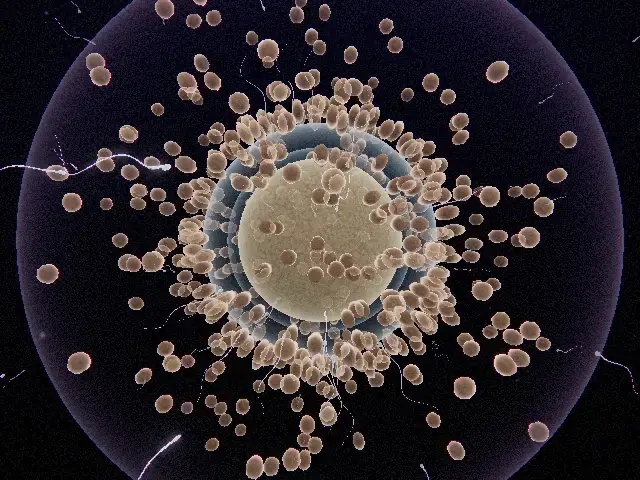
At ovulation an egg bursts out of the ovary, and the fringes at the end of the tube sweep it inside. It is the largest cell in the human body: a dot smaller than the full stop at the end of this sentence, at the very edge of what the eye can see. It is wrapped in a cloud of helper cells and a thick clear shell. Only a few dozen sperm at most reach it, and to fertilise it a sperm must push through both layers.
- Where
- Fallopian tube · ampulla
- How long
- The egg lives 12–24 hours
In numbers
- MeasuredEgg diameter: about 0.11–0.12 mm
- MeasuredZona pellucida: about 15–20 µm thick
- EstimateSperm reaching the egg: a few dozen at most (never counted in people)
Every number is labelled measured, an estimate or drawn: how we know.
The science
The human oocyte is about 110–120 µm across. It is surrounded by the zona pellucida, a glycoprotein shell about 15–20 µm thick, and by the corona radiata: granulosa cells held in a gel of hyaluronic acid. Sperm tunnel through with the enzyme hyaluronidase on their surface and their hyperactivated beat. The egg survives about 12–24 hours after ovulation, so fertilisation must happen within that window, usually here, in the ampulla, the widest part of the tube. The small sphere beside the egg is its first polar body.
In Endo-View
This is chapter 5 of the journey to life, an interactive 3D simulation at true scale: watch it, slow it down or run it at real speed, and read every number with its label.
The other chapters
What Happens to Sperm After Ejaculation How Sperm Get Through the Cervix: Cervical Mucus Sperm in the Uterus: The Race and the White Blood Cells Sperm in the Fallopian Tube: Waiting for the Egg How Fertilisation Works: Sperm Meets Egg The Zygote and the First Cell Divisions What Is a Blastocyst? Days 3 to 6 How Implantation Works: Days 6 to 12 The Fetus from Week 10 to Week 20 Pregnancy Week by Week: The Fetus to Week 40 How Birth Works: Labour and the First Breath The Embryo Week by Week: Weeks 4 to 10
More of the body
The heart and blood vessels The lungs and airways The digestive system The kidneys and the urinary system The brain and the nervous system