The journey to life · chapter 6
How Fertilisation Works: Sperm Meets Egg
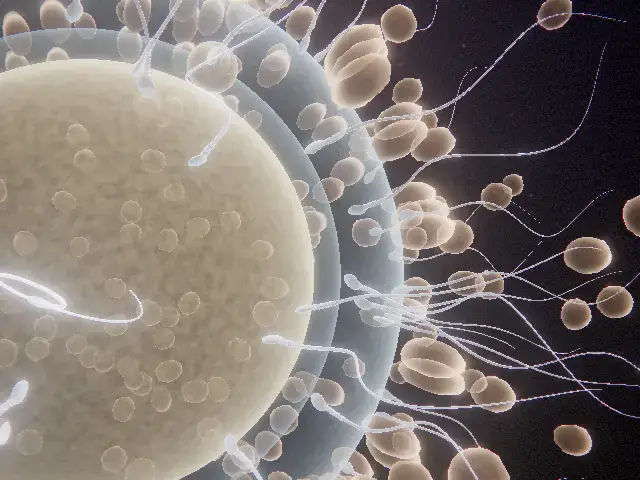
On the way in, the cap on a sperm's head bursts open and releases enzymes. The sperm grips the clear shell and cuts a narrow path through. Its head touches the egg, and the two cells merge. At once a wave sweeps across the egg, and over the next minutes to hours the shell hardens: every other sperm is locked out. Of all the millions that set out, exactly one is inside.
- Where
- Fallopian tube · ampulla
- How long
- Minutes
In numbers
- MeasuredSperm meets egg: IZUMO1 binds JUNO
- MeasuredSperm that fertilise the egg: 1
- DrawnThe calcium wave is drawn as light; it is invisible without dyes
Every number is labelled measured, an estimate or drawn: how we know.
The science
In the acrosome reaction the sperm's cap releases enzymes such as acrosin. It often happens before the zona, in the cloud of cells around the egg; in human eggs in the laboratory the zona proteins ZP1, ZP3 and ZP4 can set it off. The sperm binds the zona protein ZP2 and cuts an oblique path through. The sperm protein IZUMO1 binds the egg's receptor JUNO, which holds the two cells together, and the membranes fuse. The sperm delivers the enzyme PLCζ, which sets off waves of calcium inside the egg within seconds. Within minutes the egg releases its cortical granules and a burst of zinc; over hours ZP2 is cut and the zona hardens. This is the block to polyspermy. The whole sperm, tail included, is drawn into the egg.
In Endo-View
This is chapter 6 of the journey to life, an interactive 3D simulation at true scale: watch it, slow it down or run it at real speed, and read every number with its label.
The other chapters
What Happens to Sperm After Ejaculation How Sperm Get Through the Cervix: Cervical Mucus Sperm in the Uterus: The Race and the White Blood Cells Sperm in the Fallopian Tube: Waiting for the Egg The Human Egg Cell: Its Size and Its Layers The Zygote and the First Cell Divisions What Is a Blastocyst? Days 3 to 6 How Implantation Works: Days 6 to 12 The Fetus from Week 10 to Week 20 Pregnancy Week by Week: The Fetus to Week 40 How Birth Works: Labour and the First Breath The Embryo Week by Week: Weeks 4 to 10
More of the body
The heart and blood vessels The lungs and airways The digestive system The kidneys and the urinary system The brain and the nervous system