The journey to life · chapter 7
The Zygote and the First Cell Divisions
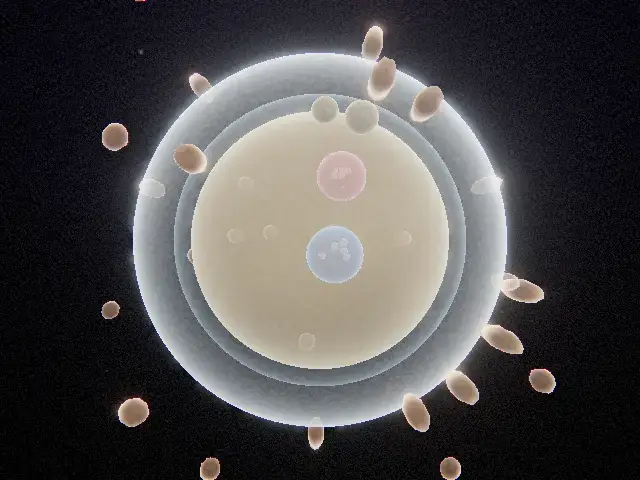
Now there is a single new cell: the zygote. Inside it, two small bubbles, one holding the mother's DNA and one the father's, drift towards each other. After about a day they meet, their chromosomes join, and the cell divides in two. Then four. Then eight. Over the next week this ball of cells travels down the tube and settles into the wall of the womb. That is where the next part of the story begins: pregnancy.
- Where
- Fallopian tube
- How long
- Day 1 to day 3
In numbers
- MeasuredChromosomes: 23 from each parent, 46 in all
- MeasuredFirst division: about 24–30 hours
- MeasuredImplantation: 6–12 days after ovulation, most often 8–10
Every number is labelled measured, an estimate or drawn: how we know.
The science
After fusion, the egg completes its second meiotic division and pushes out a second polar body. The sperm's DNA unpacks into the male pronucleus and the egg's forms the female pronucleus. Over about 12–20 hours they move to the centre; then their membranes break down and the 23 + 23 chromosomes line up for the first mitosis, about 24–30 hours after fertilisation. The embryo reaches 8 cells around day 3, becomes a blastocyst around day 5, and implants in the womb 6–12 days after ovulation, most often on days 8–10.
In Endo-View
This is chapter 7 of the journey to life, an interactive 3D simulation at true scale: watch it, slow it down or run it at real speed, and read every number with its label.
The other chapters
What Happens to Sperm After Ejaculation How Sperm Get Through the Cervix: Cervical Mucus Sperm in the Uterus: The Race and the White Blood Cells Sperm in the Fallopian Tube: Waiting for the Egg The Human Egg Cell: Its Size and Its Layers How Fertilisation Works: Sperm Meets Egg What Is a Blastocyst? Days 3 to 6 How Implantation Works: Days 6 to 12 The Fetus from Week 10 to Week 20 Pregnancy Week by Week: The Fetus to Week 40 How Birth Works: Labour and the First Breath The Embryo Week by Week: Weeks 4 to 10
More of the body
The heart and blood vessels The lungs and airways The digestive system The kidneys and the urinary system The brain and the nervous system