The journey to life · chapter 4
Sperm in the Fallopian Tube: Waiting for the Egg
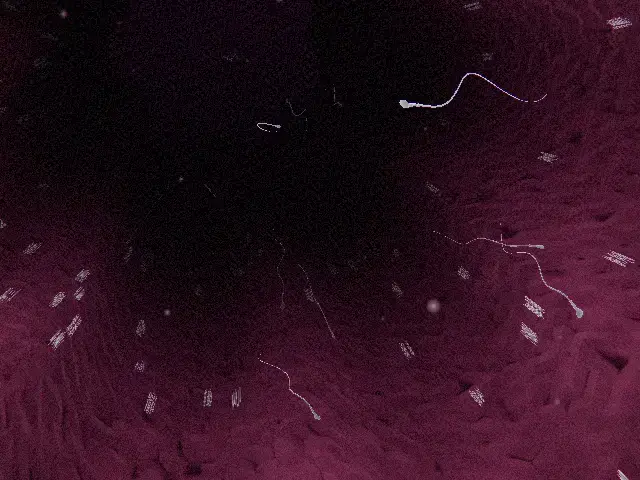
The fallopian tube is lined with tiny hairs called cilia, beating like a field of grass in the wind. In many animals, sperm stick to the wall of the tube and rest there, kept alive until an egg is released; in people this is less certain. While they wait they change: their outer coat is stripped away, and they start to swim in a new, powerful way, whipping their tails hard. Now they are able to fertilise an egg.
- Where
- Fallopian tube · isthmus
- How long
- Hours to days
In numbers
- MeasuredA cilium is about 5–10 µm long
- MeasuredFallopian tube length: about 10–12 cm
- EstimateIn the right tube: tens to a few hundred
Every number is labelled measured, an estimate or drawn: how we know.
The science
In many mammals the isthmus, the narrow first third of the tube, is a sperm reservoir: sperm heads bind to sugars on the cells of the lining, which slows their ageing. In women the evidence is weaker: human sperm bind to these cells in the laboratory, but the one direct study found none bound to the wall. Over several hours, capacitation removes cholesterol and proteins from the sperm's membrane. Calcium entering through CatSper channels then drives hyperactivation, an asymmetric, high-amplitude beat that frees sperm from the wall and drives them through thick fluid. Cilia are about 5–10 µm long and beat several times per second.
In Endo-View
This is chapter 4 of the journey to life, an interactive 3D simulation at true scale: watch it, slow it down or run it at real speed, and read every number with its label.
The other chapters
What Happens to Sperm After Ejaculation How Sperm Get Through the Cervix: Cervical Mucus Sperm in the Uterus: The Race and the White Blood Cells The Human Egg Cell: Its Size and Its Layers How Fertilisation Works: Sperm Meets Egg The Zygote and the First Cell Divisions What Is a Blastocyst? Days 3 to 6 How Implantation Works: Days 6 to 12 The Fetus from Week 10 to Week 20 Pregnancy Week by Week: The Fetus to Week 40 How Birth Works: Labour and the First Breath The Embryo Week by Week: Weeks 4 to 10
More of the body
The heart and blood vessels The lungs and airways The digestive system The kidneys and the urinary system The brain and the nervous system