The journey to life · chapter 8
What Is a Blastocyst? Days 3 to 6
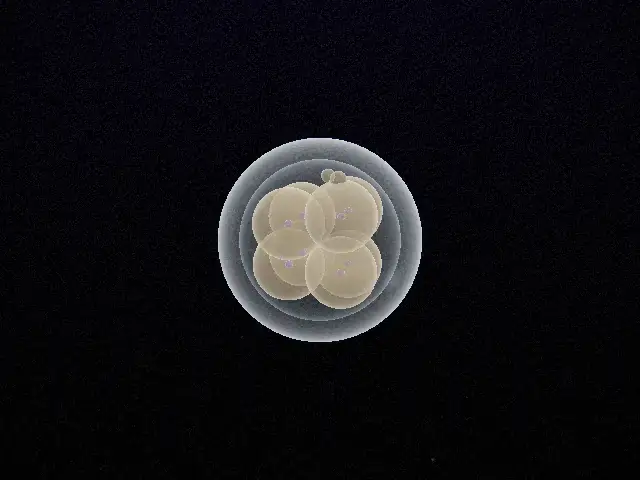
The eight cells press tightly together and keep dividing: sixteen, then thirty-two, a tiny ball like a mulberry. All the while it drifts down the tube, and around day 4 it slips into the womb. Then fluid seeps in and opens a hollow inside it. Now the cells take on different jobs: a thin outer wall that will become the placenta, and a small cluster on one side that will become the baby. Between day 5 and day 7 the ball squeezes out through a crack in its shell. It has hatched, and it is ready to hold on.
- Where
- Fallopian tube → uterus
- How long
- Day 3 to day 6
In numbers
- MeasuredMorula on day 4; blastocyst on day 5
- MeasuredAbout 60 cells on day 5, 125 on day 7
- EstimateExpanded, about 0.1–0.3 mm across
Every number is labelled measured, an estimate or drawn: how we know.
The science
Around the 8-cell stage the blastomeres compact: they flatten against each other and seal their contacts with tight junctions, and the embryo's own genes have switched on. By day 4 it is a morula of 16–32 cells (Latin morus, a mulberry). Pumps in the outer cells draw fluid inward to open the blastocoel, and the cells split into two lineages: the trophectoderm, an outer epithelium that gives rise to the placenta, and the inner cell mass, which gives rise to the embryo itself. The blastocyst swells, which thins the zona pellucida, and breaks out of it on about day 5–7 (hatching), helped by enzymes and by swelling and collapsing again and again. Human blastocysts grown in the laboratory had about 60 cells on day 5, 85 on day 6 and 125 on day 7.
In Endo-View
This is chapter 8 of the journey to life, an interactive 3D simulation at true scale: watch it, slow it down or run it at real speed, and read every number with its label.
The other chapters
What Happens to Sperm After Ejaculation How Sperm Get Through the Cervix: Cervical Mucus Sperm in the Uterus: The Race and the White Blood Cells Sperm in the Fallopian Tube: Waiting for the Egg The Human Egg Cell: Its Size and Its Layers How Fertilisation Works: Sperm Meets Egg The Zygote and the First Cell Divisions How Implantation Works: Days 6 to 12 The Fetus from Week 10 to Week 20 Pregnancy Week by Week: The Fetus to Week 40 How Birth Works: Labour and the First Breath The Embryo Week by Week: Weeks 4 to 10
More of the body
The heart and blood vessels The lungs and airways The digestive system The kidneys and the urinary system The brain and the nervous system