The journey to life · chapter 9
How Implantation Works: Days 6 to 12
The tiny ball touches the wall of the womb, turns its baby side towards it, and sticks. Its outer cells melt together into a layer that eats its way into the lining, and within a few days the whole embryo is buried inside the wall, which closes over it. Small pools open in that layer and reach the mother's tiny blood vessels: the first link between them, long before there is a cord. (Her blood only really flows into the placenta later, around weeks 10–12.) The layer also makes a hormone, hCG, which tells the mother's body to keep the lining and skip the next period. That hormone is what a pregnancy test detects.
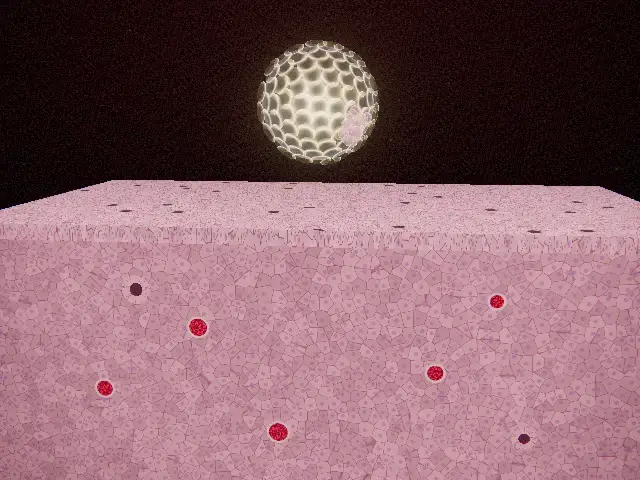
- Where
- Uterus · its lining
- How long
- Day 6 to day 12
In numbers
- MeasuredImplantation: 6–12 days after ovulation, most often 8–10
- MeasuredFully buried in the lining by about day 10
- DrawnhCG is drawn as light; it is invisible
Every number is labelled measured, an estimate or drawn: how we know.
The science
The blastocyst attaches by its embryonic pole, usually high on the back wall of the uterus. Where it touches, the trophoblast divides into an inner cytotrophoblast, still made of separate cells, and an outer syncytiotrophoblast, one mass with many nuclei, which invades the stroma of the lining. By about day 10 the conceptus is fully embedded and a plug of fibrin seals the way in. Lacunae open in the syncytiotrophoblast and, as it erodes the mother's capillaries, make first contact with her blood. Plugs of trophoblast cells keep her spiral arteries closed for most of the first trimester, so real blood flow into the placenta begins only around weeks 10–12. Meanwhile the inner cell mass becomes a disc of two layers, epiblast and hypoblast, and the amniotic cavity opens between the epiblast and the trophoblast. The syncytiotrophoblast secretes hCG, which keeps the corpus luteum making progesterone. In a study that measured hormones every day, implantation (timed by the first hCG in urine) came 6–12 days after ovulation, most often on days 8–10. Many pregnancies end around this time, most before anyone knows.
In Endo-View
This is chapter 9 of the journey to life, an interactive 3D simulation at true scale: watch it, slow it down or run it at real speed, and read every number with its label.
The other chapters
What Happens to Sperm After Ejaculation How Sperm Get Through the Cervix: Cervical Mucus Sperm in the Uterus: The Race and the White Blood Cells Sperm in the Fallopian Tube: Waiting for the Egg The Human Egg Cell: Its Size and Its Layers How Fertilisation Works: Sperm Meets Egg The Zygote and the First Cell Divisions What Is a Blastocyst? Days 3 to 6 The Fetus from Week 10 to Week 20 Pregnancy Week by Week: The Fetus to Week 40 How Birth Works: Labour and the First Breath The Embryo Week by Week: Weeks 4 to 10
More of the body
The heart and blood vessels The lungs and airways The digestive system The kidneys and the urinary system The brain and the nervous system