The journey to life · chapter 12
Pregnancy Week by Week: The Fetus to Week 40
The last twenty weeks are for growing, and for getting ready to live outside. The fetus grows from about 25 centimetres from head to heel and a third of a kilo to about 50 centimetres and 3 to 3.5 kilos. Fat builds up under its skin, so it fills out and will keep warm after birth, and a waxy cream, the vernix, protects its skin in the water. At about week 26 to 28 the eyes open, and it blinks. It hears its mother's heartbeat and her voice. It practises breathing, moving the fluid in and out, while its lungs learn to make the substance that will keep them open once they fill with air. Babies born from about week 24 can sometimes survive with intensive care, and every week longer inside helps. As the room runs out it moves less wildly, and between weeks 32 and 36 most babies turn head down, ready to be born. A baby is full term from week 37. The due date is week 40, but only a few babies are born on that day.
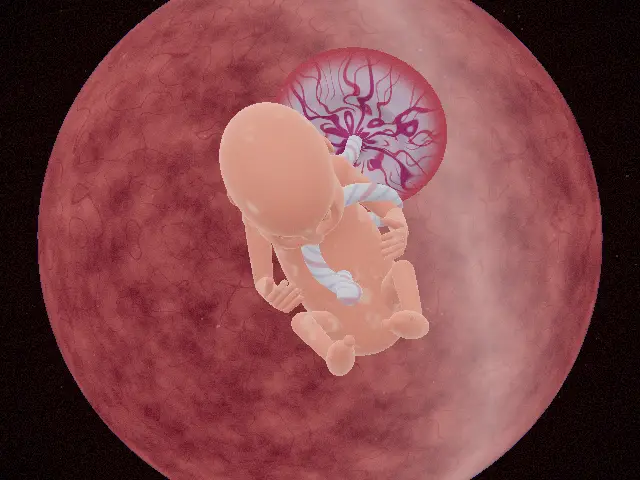
- Where
- Uterus · the amniotic sac
- How long
- Week 20 to week 40 of pregnancy
In numbers
- MeasuredWeight: about 330 g at week 20, 1.2 kg at week 28, 3.6 kg at week 40 (a typical chart)
- MeasuredAt birth: on average about 50 cm and 3.3 kg
- MeasuredBabies born from about weeks 22–24 can sometimes survive with intensive care
- MeasuredThe lungs make enough surfactant to breathe easily from about weeks 34–36
- MeasuredAbout 3–4% of babies are bottom first at term
- MeasuredFull term: weeks 37–42; only about 4% are born on the due date
- DrawnThe shape and the movements are drawn from references; the size is true
Every number is labelled measured, an estimate or drawn: how we know.
The science
By Hadlock's chart (the 50th centile) the estimated weight rises from about 330 g at week 20 to about 1.2 kg at week 28, 2.8 kg at week 36 and 3.6 kg at week 40; at birth the average is about 3.3 kg and 50 cm (WHO). Near term the fetus gains about 200 g a week, much of it fat. The lungs develop in stages: at about week 24 the first thin-walled air sacs appear, with the cells that make surfactant, the film that stops the air sacs from collapsing; surfactant is made in quantity from about weeks 34–36, which is why babies born earlier often need help to breathe, and why steroids are given to a mother before an early birth. Babies born at about 22–24 weeks can sometimes survive with intensive care, and their chances rise steeply with each week. The eyelids reopen at about weeks 26–28, and from about week 24–26 the fetus responds to sound. Most settle head down (cephalic) by weeks 32–36; about 3–4% are bottom first (breech) at term, and some of these can be turned, or are born by caesarean section. Full term is 37 to 42 weeks: the due date is 40 weeks after the first day of the last period, and only about 4% of babies are born on it. Twins usually come earlier, on average at about 35–36 weeks. Over the pregnancy the mother's blood volume rises by about 45%, and the womb grows from about 70 g to about 1.1 kg; from week 20 to week 36 the height of its top above the pubic bone, in centimetres, is about the week number.
In Endo-View
This is chapter 12 of the journey to life, an interactive 3D simulation at true scale: watch it, slow it down or run it at real speed, and read every number with its label.
The other chapters
What Happens to Sperm After Ejaculation How Sperm Get Through the Cervix: Cervical Mucus Sperm in the Uterus: The Race and the White Blood Cells Sperm in the Fallopian Tube: Waiting for the Egg The Human Egg Cell: Its Size and Its Layers How Fertilisation Works: Sperm Meets Egg The Zygote and the First Cell Divisions What Is a Blastocyst? Days 3 to 6 How Implantation Works: Days 6 to 12 The Fetus from Week 10 to Week 20 How Birth Works: Labour and the First Breath The Embryo Week by Week: Weeks 4 to 10
More of the body
The heart and blood vessels The lungs and airways The digestive system The kidneys and the urinary system The brain and the nervous system