The journey to life · chapter 11
The Fetus from Week 10 to Week 20
After week 10 the embryo is called a fetus. Every organ has begun, and from now on it mostly grows, and fast: from about 3 centimetres and a few grams to about 16 centimetres from the top of its head to its bottom, and about a third of a kilo, by week 20. It floats in the warm fluid of the amniotic sac, tied by the cord to the placenta on the wall of the womb. For now the placenta does the work of its lungs, gut and kidneys: through the cord, oxygen and food from the mother come in and waste goes out, but her blood and its blood never mix. It moves from early on. It stretches, kicks, turns over and hiccups, and from about week 15 it may suck its thumb. It is so small, with so much room, that the mother usually first feels it only between weeks 16 and 20, as a flutter. Its eyelids are closed, and they stay shut until about week 26.
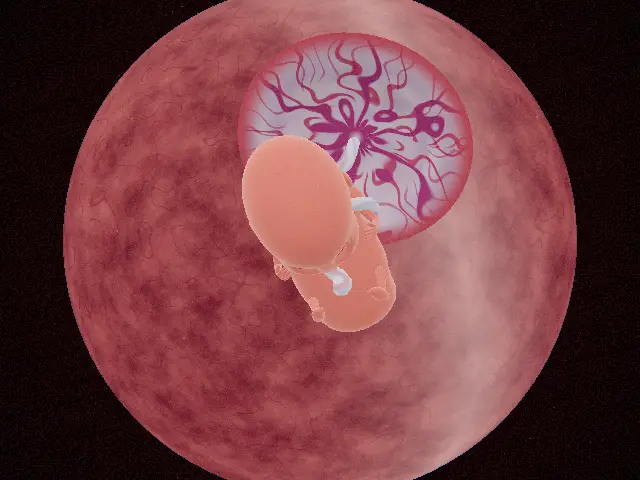
- Where
- Uterus · the amniotic sac
- How long
- Week 10 to week 20 of pregnancy
In numbers
- MeasuredCrown to rump: about 5.6 cm at week 12, about 16 cm at week 20
- MeasuredWeight: about 15 g at week 12, about 330 g at week 20
- MeasuredFirst movements felt by the mother at about weeks 16–20, earlier in a later pregnancy
- MeasuredThe cord has two arteries and one vein
- MeasuredThe eyelids are shut from about week 10 to about weeks 26–28
- DrawnThe shape and the movements are drawn from references; the size is true
Every number is labelled measured, an estimate or drawn: how we know.
The science
The embryonic period ends at the end of week 8 after fertilisation (week 10 of pregnancy); from then on the organs are formed and mostly grow and mature. On ultrasound the size is measured as the crown-to-rump length until about week 14, then from the head, the belly and the thigh bone, from which the weight is estimated. Crown to rump is about 5.6 cm at week 12 and about 16 cm at week 20, when the length from the head to the heel is about 25 cm; the weight passes 100 g at about week 16 and is about 330 g at week 20. In the placenta the fetus's capillaries run in branching villi that lie in pools of the mother's blood: gases, nutrients and waste cross a thin barrier, and the two circulations do not mix. The cord holds two arteries, which carry the fetus's blood to the placenta, and one vein, which brings it back full of oxygen, coiled in a protective jelly (Wharton's jelly). The first movements show on ultrasound at about weeks 7–8, hiccups soon after; a mother usually feels movements (quickening) at about weeks 16–20, earlier in a later pregnancy. The fetus swallows the fluid and passes urine into it, and from about the middle of pregnancy most of the fluid is its urine; breathing movements move fluid in and out of the lungs and help them grow. The eyelids fuse at about week 10 and open again at about weeks 26–28. The routine anomaly scan is done at about weeks 18–22.
In Endo-View
This is chapter 11 of the journey to life, an interactive 3D simulation at true scale: watch it, slow it down or run it at real speed, and read every number with its label.
The other chapters
What Happens to Sperm After Ejaculation How Sperm Get Through the Cervix: Cervical Mucus Sperm in the Uterus: The Race and the White Blood Cells Sperm in the Fallopian Tube: Waiting for the Egg The Human Egg Cell: Its Size and Its Layers How Fertilisation Works: Sperm Meets Egg The Zygote and the First Cell Divisions What Is a Blastocyst? Days 3 to 6 How Implantation Works: Days 6 to 12 Pregnancy Week by Week: The Fetus to Week 40 How Birth Works: Labour and the First Breath The Embryo Week by Week: Weeks 4 to 10
More of the body
The heart and blood vessels The lungs and airways The digestive system The kidneys and the urinary system The brain and the nervous system